
This past week, the tragic deaths of Rob Reiner and his wife at the hands of their own son have shaken a lot of people. Stories like this hit especially hard because they strike at something deeply human. Family. Trust. Love. The idea that something so dark could unfold inside a home that, from the outside, appeared safe and successful.
There is nothing light or easy about a story like this. It deserves care, compassion, and respect for everyone involved. And at the same time, it presents an opportunity to step back and look at how we engage with tragedy itself, especially in an age where our phones deliver the worst moments of humanity straight into our hands, hour after hour.
The problem with constant exposure to tragedy
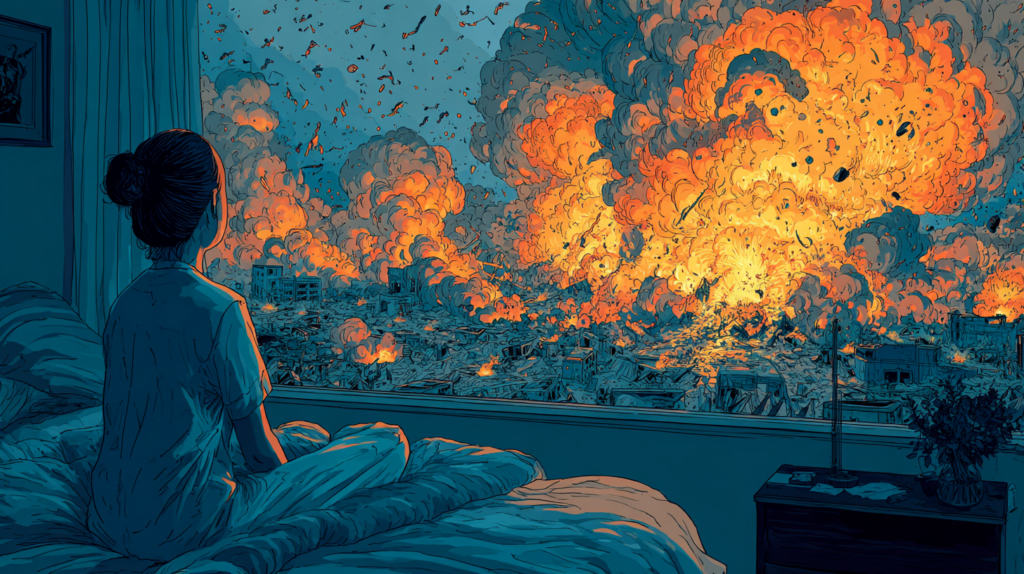
We all want to stay informed. That is reasonable. Knowing what is happening in the world helps us feel connected and prepared. But there is a difference between being informed and being saturated.
Modern media runs on attention. And attention is most easily captured through fear, shock, outrage, and horror. The old newsroom saying is still true today: if it bleeds, it leads. Violent crimes, disasters, betrayals, and breakdowns rise to the top of feeds not because they are most common, but because they are most clickable.
When we scroll endlessly through stories of murder, abuse, addiction, and collapse, our nervous system does not register them as abstract information. It experiences them emotionally. The subconscious does not know the difference between something happening across the world and something happening close to home. Over time, this trains the mind to expect danger everywhere.
This is how doomscrolling slowly reshapes perception. A distorted view of reality
Here is the quiet truth that rarely gets mentioned alongside breaking news alerts. The world, statistically and practically, contains far more kindness, cooperation, healing, and ordinary goodness than it does extreme tragedy. But those stories rarely dominate timelines.
Millions of parents are loving their kids well today.
Millions of people are choosing sobriety and recovery.
Millions of families are having honest conversations and breaking cycles.
Millions of quiet victories never trend.
When the mind is fed a steady diet of only the worst outcomes, it begins to believe that darkness is the norm and light is the exception. This does not just affect mood. It affects behavior, trust, hope, and expectation.
What we repeatedly focus on becomes familiar.
What becomes familiar starts to feel inevitable.
The subconscious and what we attract
Whether someone uses the language of psychology, neuroscience, or the law of attraction, the principle is the same. Repeated focus conditions the subconscious.
If the mind is constantly scanning for danger, it will find danger.
If the mind expects betrayal, it will interpret neutral situations as threats.
If the mind lives in fear, it will make fear based decisions.
This does not mean tragedy is attracted by thinking about it. That kind of framing is harmful and unfair. What it does mean is that prolonged exposure to negativity trains us to live in a state of emotional contraction, where curiosity, patience, empathy, and connection become harder to access.
Living in that state makes it harder to be present with our children. Harder to listen instead of react. Harder to notice when someone we love is quietly struggling.
Turning toward communication, not fear

One of the most important conversations this moment invites is about communication within families, especially with kids and young adults. Not surface level check ins, but real listening. The kind where phones are down, defenses are lowered, and curiosity replaces judgment.
Many people who fall into addiction, despair, or destructive behavior did not feel seen long before they acted out. Pain does not usually explode without first being ignored.
Leading by example matters more than lectures ever will.
How we regulate our emotions teaches more than what we say.
How we handle stress becomes the blueprint our kids inherit.
When children grow up watching adults numb out, panic, rage, or escape through substances or constant distraction, they learn that discomfort is something to run from. When they grow up seeing adults pause, breathe, talk openly, seek help, and stay grounded, they learn that darkness can be faced without being consumed by it.
Staying informed without losing your center
This is not an argument for ignorance or pretending the world is perfect. It is an argument for intentional consumption.
Some practical shifts that make a real difference:
Set boundaries around news intake. One or two intentional check ins a day is very different from endless scrolling. Balance hard news with grounding input. Nature, music, art, and real conversation matter.
Notice how your body feels after consuming media. If your shoulders are tight and your breath is shallow, it is time to stop. Talk about difficult stories instead of silently absorbing them. Shared processing reduces fear.
Most importantly, model these habits for your children. Teach them that being informed does not mean being flooded, and caring does not require constant exposure to trauma.
Choosing light without denying darkness
Finding something positive in a tragedy does not mean minimizing it. It means choosing how we respond to it.
We cannot undo what happened.
We can choose not to let fear dominate our inner world.
We can choose presence over panic.
Connection over isolation.
Awareness over numbness.
Every time we turn off the scroll and turn toward a real conversation, we reinforce life.
Every time we check in with our kids instead of assuming they are fine, we reinforce safety.
Every time we choose compassion over outrage, we shift the emotional tone of our homes.
Dark stories will continue to exist. That is part of being human. But they do not have to define our internal landscape.
Staying in the light is not about avoiding reality. It is about engaging with reality consciously, lovingly, and with enough care that we do not become hardened, disconnected, or lost along the way.
And in a world that profits from fear, that choice matters more than ever.